
Relay.app Review: Features, Pricing, and How It Compares to Zapier & Make
Relay.app is an AI-native workflow automation tool designed for teams that need smart automation with human-in-the-loop control. This article breaks down Relay.app’s features, pricing, market position, and how it compares to competitors like Zapier, Make, and n8n.
AI TOOLS DIRECTORY
Clark
1/29/20263 min read


🔎 What is Relay.app?
Relay.app is an AI-powered no-code workflow automation platform that helps teams and businesses automate tasks and cross-application processes without programming skills. It sits between traditional trigger-action automation tools and emergent AI-first automation systems.
🧠 Core Identity
AI-native automation: Built with integrated AI agents that can interpret, summarize, classify, and act on data within workflows.
Human-in-the-loop (HITL): Allows manual checkpoints, approvals, and human decision steps embedded into automated processes.
No-code visual builder: Drag-and-drop interface for building workflows and integrations without coding.
100+ native integrations: Connects popular business tools (e.g., Gmail, Slack, Notion, CRMs).
Multi-model AI support: Works with various AI models within workflows (e.g., GPT, Claude, Gemini).
In essence, Relay.app lets teams create intelligent agents and workflows that can both automate and interpret work tasks—and pause for human input when needed.
Pricing:
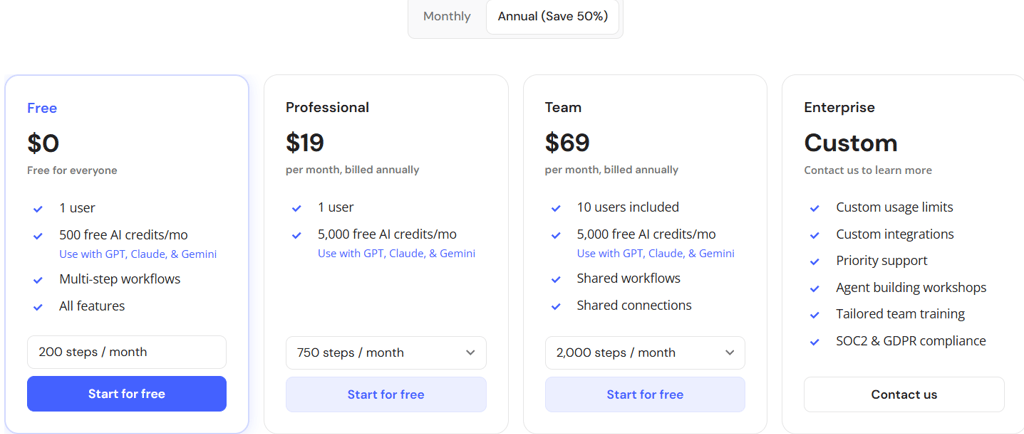
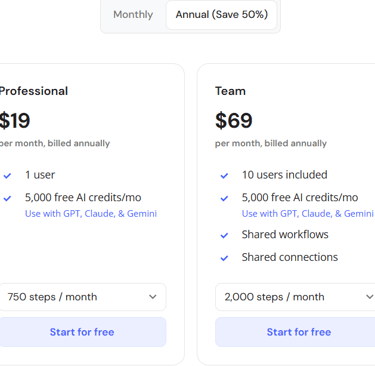
Relay.app pricing follows a tiered freemium model that scales with usage and collaboration needs. At the entry level, the Free plan costs $0 per month and includes one user, 200 automated steps and 500 AI credits — giving access to all core automation features and integrations to try out workflows risk-free. The Professional plan (starting around $19/month billed annually) increases monthly step limits and AI credits (e.g., ~750 steps and 5,000 AI credits), suited for individual power users. The Team plan (from about $69/month annually) adds support for multiple users (typically up to 10), shared workflows, and shared connections. For larger organizations with custom needs — such as higher usage caps, bespoke integrations, compliance features, and priority support — there’s an Enterprise tier with custom pricing. All plans include the same automation features; differences lie mainly in usage limits and collaboration support. More detail
📊 Market Presence & Share
📌 Market Share Snapshot
In the broader customer engagement automation segment (sometimes including CRM and messaging tools), Relay’s market share is very small (~0.01%) with limited adoption relative to leaders in the space. Intercom, Brevo, and Zoho SalesIQ far outpace it in market share in that category.
📌 Competitive Position
Relay.app is still a newer entrant in a crowded automation space dominated by platforms like Zapier, Make.com (formerly Integromat), and n8n. In overall usage and install scale, it’s not yet comparable to these major players in terms of global market footprint. This is typical for a tool focused on a niche (AI-native automation + human-in-the-loop) rather than broad tech adoption.
⚔️ Feature Comparison with Top Competitors
Key Differences Explained:
Zapier wins on sheer integration breadth and ecosystem support but offers more generic automation with AI often as an afterthought.
Make.com has a visual powerhouse editor for complex workflows, but it’s more technical and dense than Relay.app.
n8n is ideal for developers or enterprise teams needing customization or self-hosting, a category Relay.app does not target.
Relay.app’s differentiation comes from AI-native automation plus built-in human oversight, which most competitors either lack or provide as secondary add-ons.
⭐ Strengths of Relay.app
1. AI-centric automation:
AI isn’t bolted on—it’s built into the automation logic, letting you use models for data extraction, decisioning, summarization, etc. This simplifies sophisticated tasks that would be cumbersome in traditional tools.
2. Human-in-the-loop:
You don’t have to choose between full automation or full manual control. Relay.app allows workflows to pause for human review or input.
3. User friendliness:
Reviews show Relay.app scores high on ease of use and onboarding, especially for non-technical users. (G2)
4. Collaboration features:
Team workflows include role-based access and shared workspace capabilities.
⚠️ Limitations & Trade-Offs
1. Smaller integration ecosystem:
With ~100+ integrations, Relay.app supports fewer apps versus Zapier’s thousands, which may matter for certain niche workflows.
2. Growing platform:
Being newer, it doesn’t yet match the maturity or community ecosystem of long-established tools like Zapier, Make, or n8n.
3. Not leading in pure market share:
Its niche focus means it currently holds a small portion of the broader workflow automation landscape.
🏁 Bottom Line
Relay.app is an AI-focused workflow automation tool designed to make complex workflows accessible to non-technical teams while preserving human control. It excels where AI tasks, human decisions, and cross-app workflows intersect, especially for teams looking for a modern, intuitive tool rather than legacy or developer-heavy automation platforms.
However, if your priority is maximum integration coverage or enterprise-level scale, tools like Zapier and Make.com still hold larger market presence and broader integration coverage.
Read more articles at AI Tools Directory
AiToolsConsume Ltd © 2024
contact us business@aitoolsconsume.com
"Aitoolsconsume empower individuals and businesses with accessible AI tools for a brighter, more innovative future"